
The bus depot sat inside the park like it had always belonged there.
Buses came and went along the outer lanes, but the center was quieter—grass, tables, shade structures, people passing time between destinations. Vendors lined one side, and beyond them a patch of open field where a group of kids had claimed space for a game.
Aria watched them over the rim of her drink.
“They’ve been at it a while,” she said.
Virel didn’t look up right away. He was focused on finishing the last of his bento, methodical, unhurried.
“They’ll resolve it eventually,” he replied.
“They don’t look like they want to.”
That made him glance over.
The game was uneven—one side louder, more coordinated. The other scattered, reacting late, missing easy throws. A ball skipped past someone who should have caught it. Another player hesitated just long enough to be tagged.
Virel recognized that hesitation.
He looked back down at the table.
A few moments later, the game stalled. Voices carried across the field.
“We need two more!”
“Anyone—come on!”
Footsteps approached before he could pretend not to hear.
Two kids stopped at the table, hopeful, slightly out of breath.
“Do you guys want to play?”
Aria didn’t hesitate. She was already halfway standing.
“Yeah, we can—”
Virel’s hand tightened slightly around the edge of the table.
“I’m not—” he started, then paused. “I’m not very good at that.”
It came out more quietly than he intended.
One of the kids shifted, uncertain. The other just waited.
Aria glanced at him, not pushing, not teasing. Just present.
“We’re just helping them out,” she said. “It’s not serious.”
He followed her gaze back to the field.
The imbalance was obvious. The same patterns repeating. Late reactions. Missed opportunities. Small errors stacking into predictable outcomes.
He exhaled once, steady.
“…Okay,” he said.
The ground was uneven where the grass had worn thin.
Virel adjusted his footing as they took their places. The ball moved quickly—faster than it had looked from the table. Shouts overlapped. Motion layered on motion.
He tracked it all at once.
Not consciously.
Just… there.
A throw came toward him—too fast, too direct.
His body shifted.
Not a dodge, not quite. Just enough.
The ball passed where he had been.
He blinked.
That shouldn’t have worked.
Another ball came—this one angled toward Aria. She moved before it fully left the other player’s hand, stepping into open space that hadn’t existed a moment before.
She didn’t look surprised.
The rhythm of the game changed.
Not dramatically. Not all at once.
But small things began to align.
A pass arrived exactly where someone could catch it. A throw went out a fraction earlier, slipping through a gap before it closed. Movements overlapped without collision, like people were choosing the same timing without needing to say it.
Virel found himself where he needed to be before he finished deciding to move.
He caught one cleanly.
Then another.
When he threw, he didn’t force it. He released the ball where the opening would be, not where it was.
It worked.
Across from him, the other team faltered—just slightly. Their timing slipped. Their certainty didn’t match what was happening.
One by one, they were tagged out.
The last throw came fast, direct.
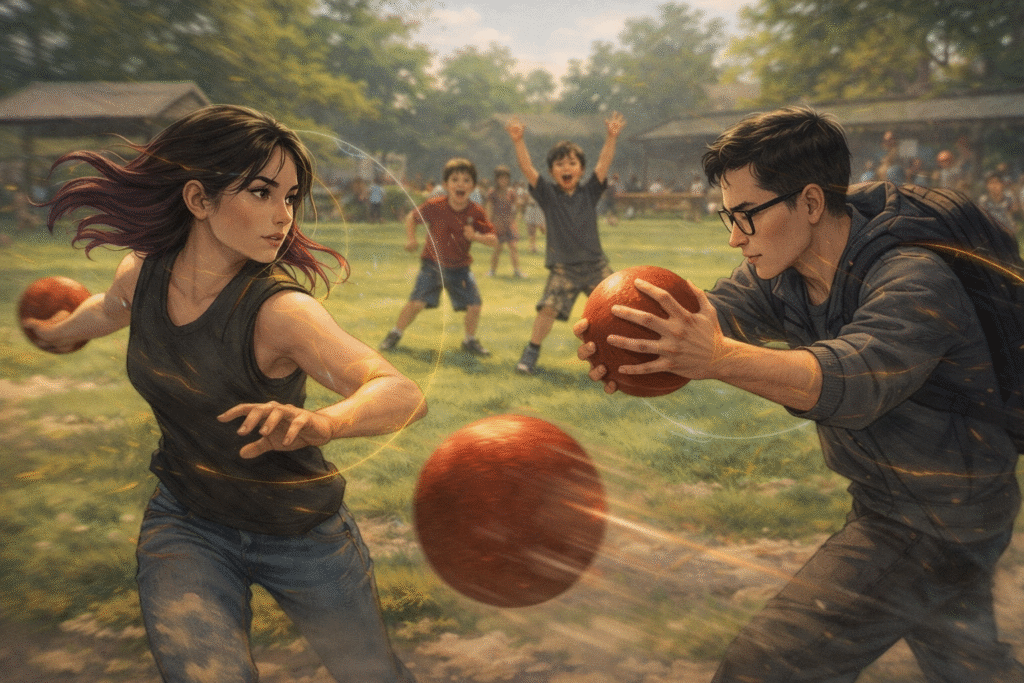
Virel saw it.
Or something in him did.
His hands moved, closing around the ball with a precision he would have called luck, once.
The impact was solid. Controlled.
The game ended a second later.
For a moment, no one moved.
Then the kids on their side erupted—shouting, laughing, already retelling what had just happened in louder, less accurate versions.
“You caught that!”
“That was perfect!”
“Where did you even—”
Virel stood there, still holding the ball.
He hadn’t been hit.
Not once.
Aria stepped closer, a small, satisfied smile tugging at the corner of her mouth.
“See?” she said.
He looked at the field, then at his hands.
“…It was different,” he said.
Not better.
Not easier.
Just… different.
The noise of the park settled back into place around them. The next game was already starting, the moment folding into everything else that was happening.
Virel rolled the ball once in his hands, then passed it back.
He didn’t step forward again.
But he didn’t step away, either.